
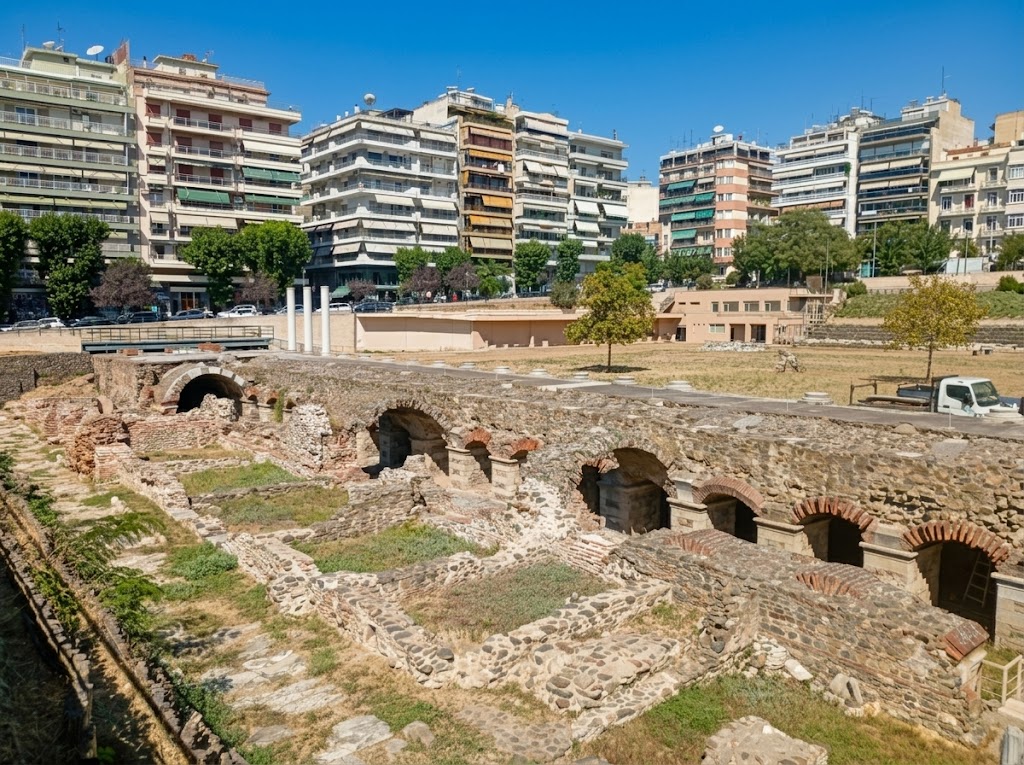
A Living Window into the Ancient Heart of a Great City
In the very center of modern Thessaloniki, just a few steps away from the busy cafes and pedestrian streets of today, lies one of northern Greece’s most remarkable archaeological treasures: the Roman Agora. Hidden beneath the city for centuries, this ancient forum was the beating heart of Roman Thessaloniki — a place where merchants haggled, citizens debated, and the social fabric of an entire civilization was woven, day after day.
A City at the Crossroads of Empires
Thessaloniki was founded in 315 BC by Cassander, King of Macedon, who named it after his wife — the half-sister of Alexander the Great. Its position on the Via Egnatia, the great Roman road connecting Rome to Constantinople, made it one of the most strategically important cities in the ancient world. Where major roads meet, power follows — and with power comes monumental architecture.
When the Romans consolidated their control over Macedonia, they transformed Thessaloniki into a regional capital and model Roman city. Following classic urban planning principles, they laid out the city along two main axes: the cardo, running north to south, and the decumanus, running east to west. At their intersection — the most prestigious location in any Roman city — they built the Agora.
Building the Forum: History in Stone
The construction of the Roman Agora is generally dated between 42 BC and 138 AD, a period that saw Rome at the height of its imperial ambition. Some scholars, however, argue that major phases of construction belong to the later Tetrarchic period — the late 3rd and early 4th century AD — when Thessaloniki served as one of the four capitals of the Roman Empire under Galerius.
The Agora followed the standard blueprint of Roman forums across the Empire: a large rectangular open courtyard, paved with marble slabs, flanked on all sides by covered colonnaded walkways known as stoas. Around this central square stood shops (tabernae), administrative offices, and public buildings. It was simultaneously a marketplace, a civic center, and a stage for public life.
💡 Did you know? The western arcade of the Agora was known as the “Copper Arcade” because it was home to many coppersmiths. This tradition survives to this day — Chalkeon Street (from the Greek word for copper) nearby is still associated with metalwork and crafts.
One of the most striking features of the Agora was the so-called “Arcade of Images” at the southeastern entrance. Until the 19th century, a remarkable group of female statues stood here, carved as two-faced pillars depicting mythological figures — Maenad, Ariadne, Leda, Nike, and others. Locals affectionately called them the Ikantada (“the enchanted ones”). Sadly, these sculptures were removed and now reside in the Louvre Museum in Paris.
Rediscovered by Accident
Like so many ancient wonders, the Roman Agora did not announce itself — it was found by chance. In 1966, during urban construction work in the city center, workers’ tools struck ancient stone. What followed was one of the largest and most significant archaeological excavations in Thessaloniki’s modern history. The planned building project was halted, and archaeologists were called in to uncover what lay beneath.
What they found was extraordinary: the remains of a two-terraced forum, a well-preserved Odeon (a small covered theater), colonnaded walkways, and an underground museum space that would eventually be opened to the public. Restoration work began in earnest in 1989 and continues to this day.
The Odeon: Where Ancient Voices Still Echo
One of the highlights of any visit to the Roman Agora is the restored Odeon — a semicircular amphitheater that once hosted musical performances, poetry recitals, and civic gatherings. Today, the Odeon has been carefully restored and is used for cultural events, concerts, and performances during Thessaloniki’s vibrant festival season. Sitting in its stone seats at dusk, watching a live performance, is an experience that collapses two thousand years of history into a single, unforgettable moment.
What to See Today
The site as it stands today offers visitors a layered experience of ancient urban life. Walking through the Agora, you can explore:
- The expansive marble-paved central courtyard
- Restored Corinthian columns standing tall against the Thessaloniki skyline
- The remains of colonnaded stoas and ancient shop foundations
- The restored Odeon amphitheater
- An underground museum displaying artifacts and explaining the site’s history — with innovative tactile replicas accessible to visually impaired visitors
A Site Within a City of Sites
The Roman Agora does not stand alone — it is the centerpiece of a remarkable cluster of ancient monuments in Thessaloniki’s historical core. A short walk east brings you to the Arch of Galerius (Kamara) and the Rotunda, both dating from the same imperial era. Nearby, the magnificent Church of Agios Dimitrios — dedicated to the city’s patron saint — contains an ancient crypt with early Christian and Roman remains. For deeper context, the Archaeological Museum of Thessaloniki and the Museum of Byzantine Culture are both easily reachable on foot.
Thessaloniki is often called the most Byzantine city in Greece — but the Roman Agora reminds us that the story begins even earlier, in the marble and ambition of an empire that once stretched from Scotland to Syria.
🗺 Visitor Tip: Combine your visit to the Roman Agora with a walk along Egnatia Street — the modern road built directly over the ancient Via Egnatia. You’ll be retracing the steps of Roman legions, medieval pilgrims, and Ottoman traders all at once.
Why It Matters
In an era when ancient history can feel distant and abstract, the Roman Agora of Thessaloniki offers something rare: immediacy. It sits not in a remote field or behind a museum wall, but in the middle of a living, breathing city. Office workers eat lunch on its steps. Children run between its columns. Tourists and locals alike pass through its ancient stones as naturally as they cross any modern square.
That continuity — ancient and modern, layered and alive — is perhaps the Agora’s greatest gift. It doesn’t ask you to imagine the past. It places you inside it.